
Retinol is one of the most researched substances in cosmetology. It's a vitamin A derivative that accelerates cell renewal, stimulates collagen production, and reduces discoloration—all at the same time. The first effects of retinol on the face can be seen after just a few weeks. Find out how to safely incorporate it into your routine and what to expect!
Retinol in brief:
Retinol – what is it? It's a vitamin A alcohol – one of many retinoids (i.e., vitamin A derivatives), but unique due to its over-the-counter availability and well-documented effects. When applied to the skin, it undergoes a two-stage conversion: first to retinaldehyde (an intermediate active form), and then to retinoic acid, which directly affects receptors in the nuclei of skin cells. Retinoic acid is the biologically active form – retinol is its more stable, better-tolerated predecessor. Our retinyl retinoate serum is an even more modern derivative that combines the stability of retinyl with the direct activity of retinoic acid.
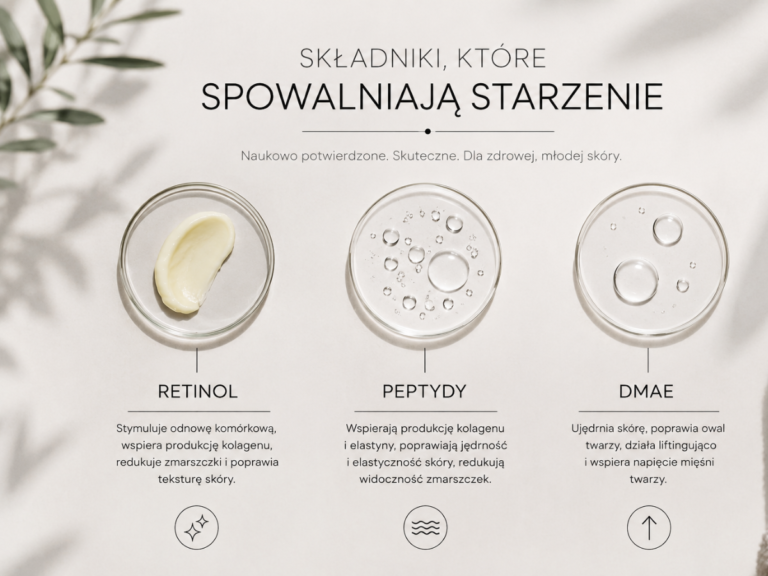
Retinol accelerates the natural cell renewal cycle by shortening the time it takes for epidermal cells to reach the surface and stimulating the exfoliation of dead skin cells. This cycle lasts approximately 28 days in a young person, but in an adult, it extends to 40-50 days. The effect is visible to the naked eye: skin becomes smoother, skin tone more even, and pores less visible.
Retinol stimulates dermal cells to produce collagen while simultaneously inhibiting the enzymes that break down existing collagen. In practice, the skin gradually regains its density and firmness – the effects are subtle in the first few weeks, but lasting with regular use.
Retinol has multifaceted effects, working simultaneously at the epidermal level (renewal, smoothing, tone) and the dermis (collagen, elastin, density). Therefore, it is the foundation of effective anti-aging routines and is also effective for treating discoloration and enlarged pores.
The first changes – smoother texture, better color – usually appear after 4-6 weeks. Visible reduction of wrinkles requires a minimum of 3-6 months of use at least three times a week. Most users experience a "retinization" phase—a period of dryness or reactivity—in the first 2-4 weeks. After that, the skin adapts and tolerance increases.
Retinol reduces discoloration two ways: accelerates the exfoliation of pigmented epidermal cells and inhibits melanogenesis (the process of skin pigment production). Effects on sun spots are usually visible after 2-3 months. Retinol in daily care It works particularly well for sun and acne discoloration, although hormonal discoloration requires the support of other ingredients. Check it out: contrary to popular belief, retinol also minimizes pore size, primarily by normalizing sebum secretion and exfoliating clogged sebaceous glands.
How do you use retinol without skin irritation? Start by using it 1-2 times a week, always in the evening, on clean, dry skin. You can read more about its uses here: What does retinol serum help with?. Give your skin 4-8 weeks to adapt before reaching for a higher concentration. If classic retinol is too strong to start with, consider retinyl retinoate – combines effectiveness with a lower risk of irritation.
Retinol application procedure in the evening:
For those who have never used retinol, a safe starting point is 0.025-0.051 TP3T. For reactive skin, start with 0.011 TP3T. Skin that has become accustomed to retinol can reach 0.1-0.31 TP3T. Higher concentration doesn't mean "it will work faster" – it means a higher risk of irritation. It's better to start lower and gradually increase.
The sandwich method involves applying retinol between two layers of moisturizer: cream – retinol – cream. The first cream creates a buffer that slows the penetration of the retinol and reduces the risk of irritation. It's especially effective at the beginning and for reactive skin. Our cream with ceramides, peptides and niacinamide.
Basic rule: you use retinol in the evening, and you separate potentially irritating ingredients over time or apply them in the morning.
Safe and profitable connections:
What to avoid in the same session as retinol? Exfoliating acids (AHA, BHA), vitamin C, and benzoyl peroxide – separate them in the morning.
Retinol is contraindicated during pregnancy, as are all retinoids. Vitamin A in excess has been shown to have an effect. teratogenic Dermatologists and dermatologists recommend avoiding all vitamin A derivatives during pregnancy and breastfeeding. After breastfeeding, you can return to a routine with lower concentrations. Bakuchiol is sometimes mentioned as a plant-based equivalent, although its effects are weaker and less documented.
Retinol has decades of clinical research behind it and remains the benchmark for new retinoids. Patience and consistency are key – without them, even the best retinol won't reach its full potential. Check out our retinyl retinoate serum and see how this modern form of retinoid delivers visible results with a lower risk of irritation!
Between the ages of 25 and 30 – this is when natural collagen production begins to slow down, although in cases of acne or discoloration you can start earlier, always with the lowest concentrations.
The feeling of tightness or dryness is a normal stage of adaptation that disappears after a few weeks - with the sandwich method the discomfort is much less.
Retinol can be used in the summer as long as you apply SPF every morning – retinol increases the skin's photosensitivity.
Cosmetic retinol has concentrations up to approximately 0.3% without a prescription, prescription retinol (tretinoin and others) is 0.5-1% and higher – much stronger and requiring medical supervision.
Footnotes: