My forehead is shiny before noon, my cheeks are tight and dry in the morning. It's a classic combination skin dilemma: one cream will always be a compromise that oils The center of the face or the sides dry out. The multi-masking strategy breaks this pattern. Instead of one formula for the entire face, each zone receives a different mask simultaneously: a clay mask for the T-zone, a creamy formula for the cheeks. Find out how to implement this technique and which ingredients to choose for each zone!
In short about combination skin:
Combination skin is characterized by excess sebum production in the T-zone and dryness on the cheeks. The center of the face becomes shiny a few hours after washing, pores enlarge and become visible. Cheeks remain dull, sometimes rough or tight. Research published in the Journal of Investigative Dermatology shows that sebaceous gland density in the T-zone it is three times higher than on the cheeks. This difference explains why the center of the face produces significantly more sebum.
Standard skincare doesn't take these differences into account. Moisturizing creams oil the T-zone, while mattifying creams dry out the cheeks. multi-masking solves the problem – you apply the clay mask to your nose and forehead, and the cream mask to the sides of your face.
Wash your face in the evening with a cleansing gel; do not apply creams. In the morning, place a blotting paper on your forehead, nose, and chin for 5 seconds, then repeat on your cheeks. Compare the marks – oily patches in the T-zone and no marks on your cheeks confirm combination skin.
The most important signals in the home test:
Our natural facial cleansing gel with plant extracts does not disturb the skin's pH balance.
Multi-masking is a technique involving the application of various masks Apply to selected facial zones simultaneously. Each zone has different needs resulting from varying sebaceous gland activity. Cover the T-zone with sebum-regulating kaolin or bentonite clay, and the cheeks with a creamy formula with hyaluronic acid or ceramides. Define the boundaries between zones precisely with your finger or a flat brush.
Multi-masking delivers ingredients exactly where they're needed. The T-zone receives mattifying minerals, and the cheeks receive deep hydration. The results appear faster than with a standard cream. Homemade and ready-made masks make it easier to get started with multi-masking.
Situations when multi-masking works best:
Observe your skin morning and evening. Tight cheeks signal a lipid deficiency, while a shiny T-zone indicates excess sebum. Touch your face with clean fingers – the center will be sticky or oily, while the sides will be dull and sometimes rough. The difference in texture between zones can be very noticeable. The cheeks may also redden in response to cold or wind, while the forehead and nose remain stable.
The most important signals of zone differentiation:
The T-zone responds to mattifying and sebum-regulating substances. need to rebuild the lipid barrier and deep hydration. Niacinamide has a universal effect – it reduces oiliness in the center of the face while strengthening the hydrolipid barrier on the sides. You can apply it to the entire face as a base serum. Salicylic acid only works in the T-zone; it can be drying on the cheeks. Apply ceramides in small dots to the sides of the face; they are unnecessary in the center – they can intensify shine.
Selection of ingredients by zone:
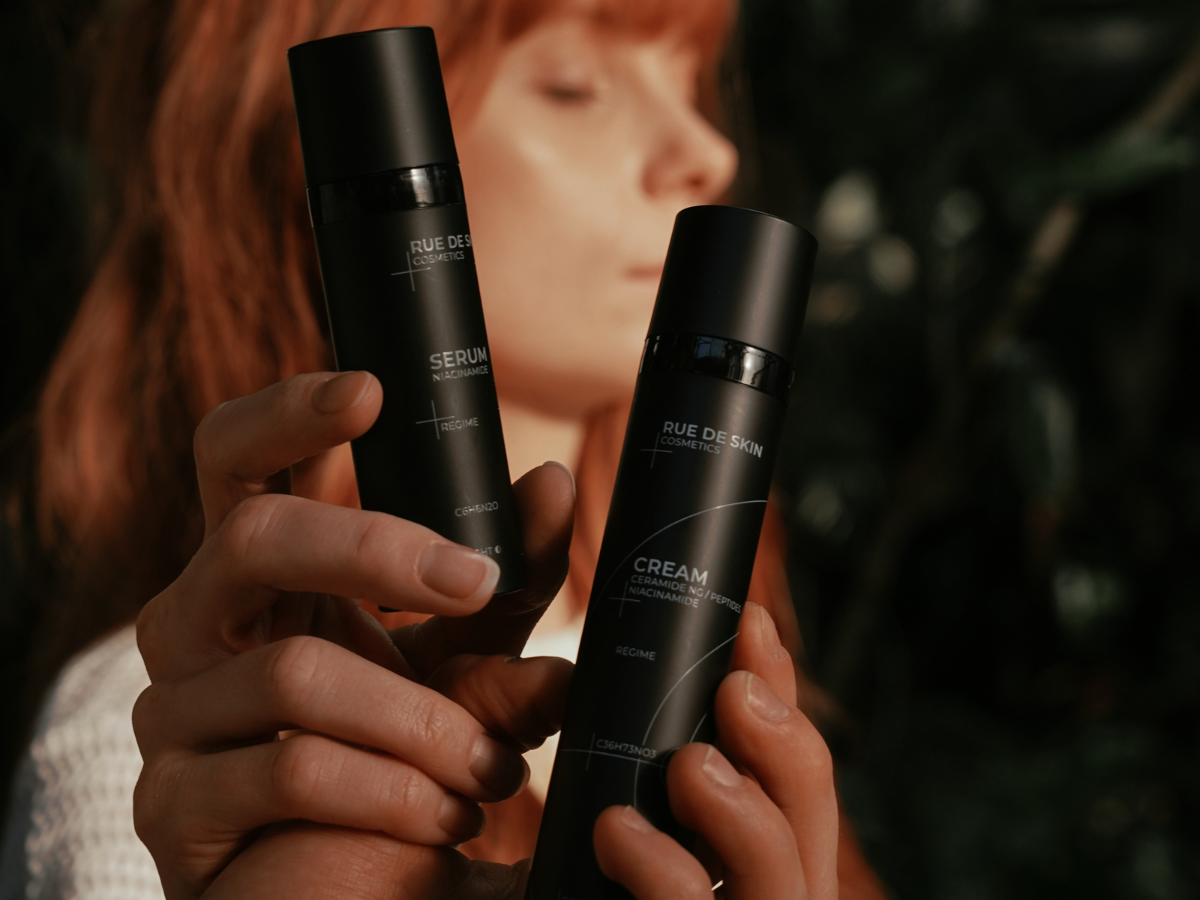
Our niacinamide serum contains 10% niacinamide and kojic acid – supports the reduction of discoloration and evens out skin tone.
Start with one session per week. Wash your face with a gel, apply a clay mask to your T-zone, and a cream mask to your cheeks. Leave on for 10-15 minutes, then wash each area separately. Don't overdo it – dried clay draws moisture from the epidermis. Start by washing off clays, then apply a moisturizing mask. This prevents transfer of ingredients between zones. After a few weeks of regular use, skin becomes more even, and differences between zones are reduced.
After masks, apply moisturizing cream with ceramides, which rebuilds the barrier and evens out skin tone. Pat it in with your fingertips, moving from the center of the face outward.
Don't combine exfoliating masks with acids – the risk of irritation increases. Don't apply clays around the eyes, the skin there is too delicate. Avoid retinoids and vitamin C immediately after exfoliating masks. Don't overexert yourself – dried clay draws water from the epidermis. Learn more about these techniques in our article – facial massages.
Once a week, wash your face thoroughly. Apply a clay mask to the T-zone and a moisturizing mask to the cheeks. Leave on for 12 minutes, then rinse. Apply a niacinamide serum, patting it in with your fingertips. Once absorbed, apply a barrier-rebuilding cream. Our skincare cosmetics Rue de Skin connects high concentrations active ingredients supporting regeneration.
Multi-masking works without drying out, provided the formulas are tailored to each zone. Each area receives what it needs.
T-zone care can worsen dryness if you apply a mattifying product to your cheeks. Multi-masking involves separating the zones—clay only in the center, and a moisturizing formula on the sides.
Introduce one product every two weeks. Combination skin can be reactive – a gradual approach minimizes the risk.
The change of seasons clearly affects the zones. In winter, cheeks become drier, while in summer, sebum production increases.
Footnotes: